Orchha, a 16th-century town founded by the Bundela Rajput chieftain Rudra Pratap on the banks of the Betwa River in Madhya Pradesh, was once the capital of the powerful Bundelkhand kingdom. Frozen in time, its palaces, temples, and cenotaphs still stand exactly as the Bundela rulers left them centuries ago. Here are the five places you simply cannot skip on a trip to Orchha.
1. Ram Raja Temple
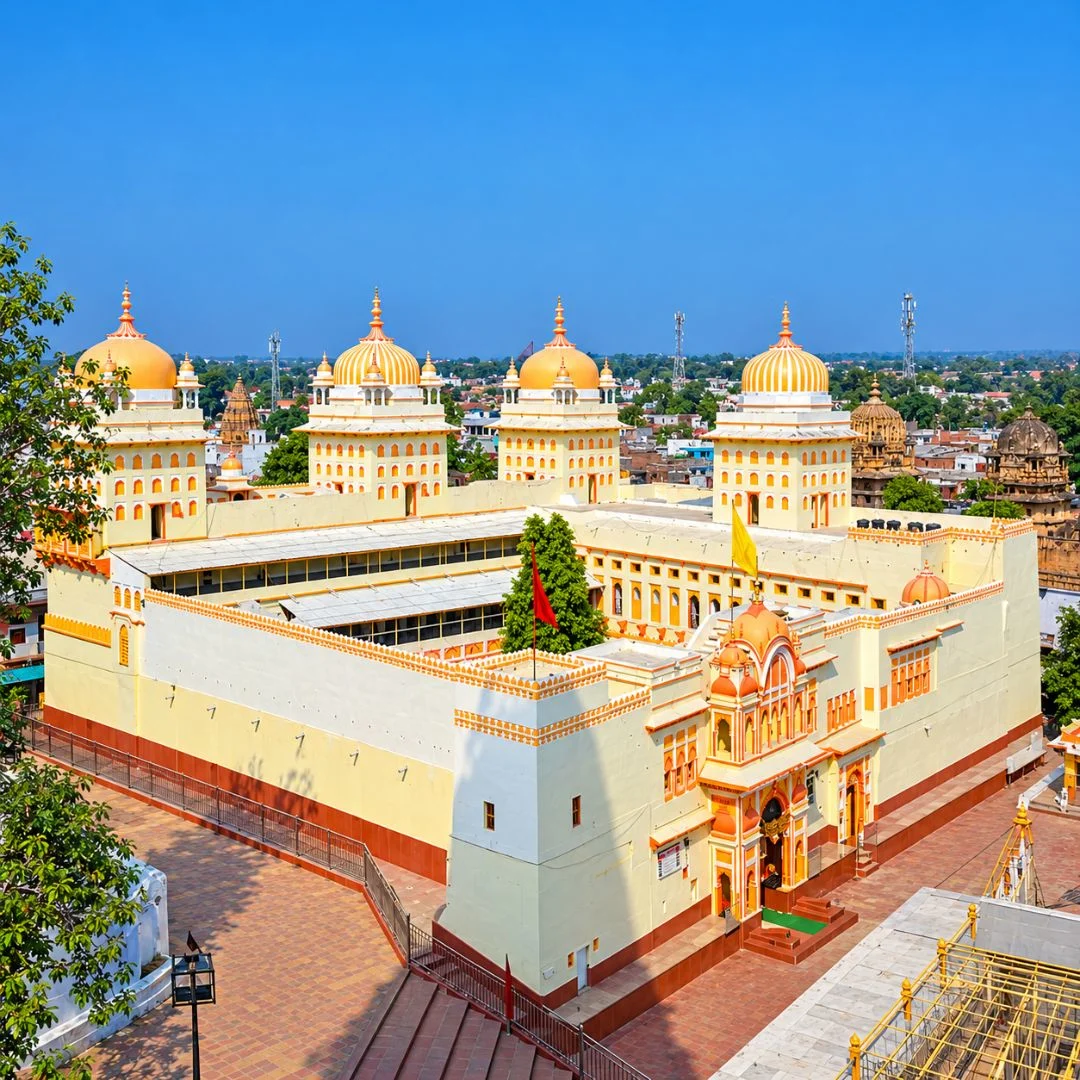
Ram Raja Temple was originally built as a palace (Rani Mahal) for Queen Ganesh Kunwari, wife of King Madhukar Shah, in the 16th century. According to legend, Lord Rama appeared to the devoted queen and agreed to travel with her to Orchha on the condition that wherever he was first placed would become his permanent home. When the idol was temporarily kept in the queen's palace while the grand Chaturbhuj Temple was still under construction, it refused to be moved — so the palace itself became a temple.
Location: Inside Orchha town, close to the main market and about 1 km from Orchha Fort Complex.
Distance: Roughly 1 km from Orchha Fort; about 18 km from Jhansi railway station, the main gateway to Orchha.
Entry to Ram Raja Temple is completely free — no ticket is required.
Temple open roughly 8:00 AM–12:30 PM and 5:00 PM–10:00 PM, with the evening Shyam Aarti — when the heavy silver doors swing open to the sound of the gun salute — being the single most popular moment to visit.
It is the only temple in India where Lord Rama is worshipped as a reigning king rather than a deity, complete with a daily police guard of honour and gun salute
usually reserved for heads of state. Devotees also flock here to spot the sandalwood tilak on Rama's left foot's toe, believed to grant wishes when seen during darshan.
The temple further comes alive each year during the grand Ram Vivah festival in Kartik month, when thousands gather to celebrate Rama and Sita's wedding with
elaborate processions.
Inspired by this divine celebration, many couples now hire an Orchha wedding planner to recreate the same royal grandeur for their own destination wedding in this historic town.
2. Orchha Fort Complex
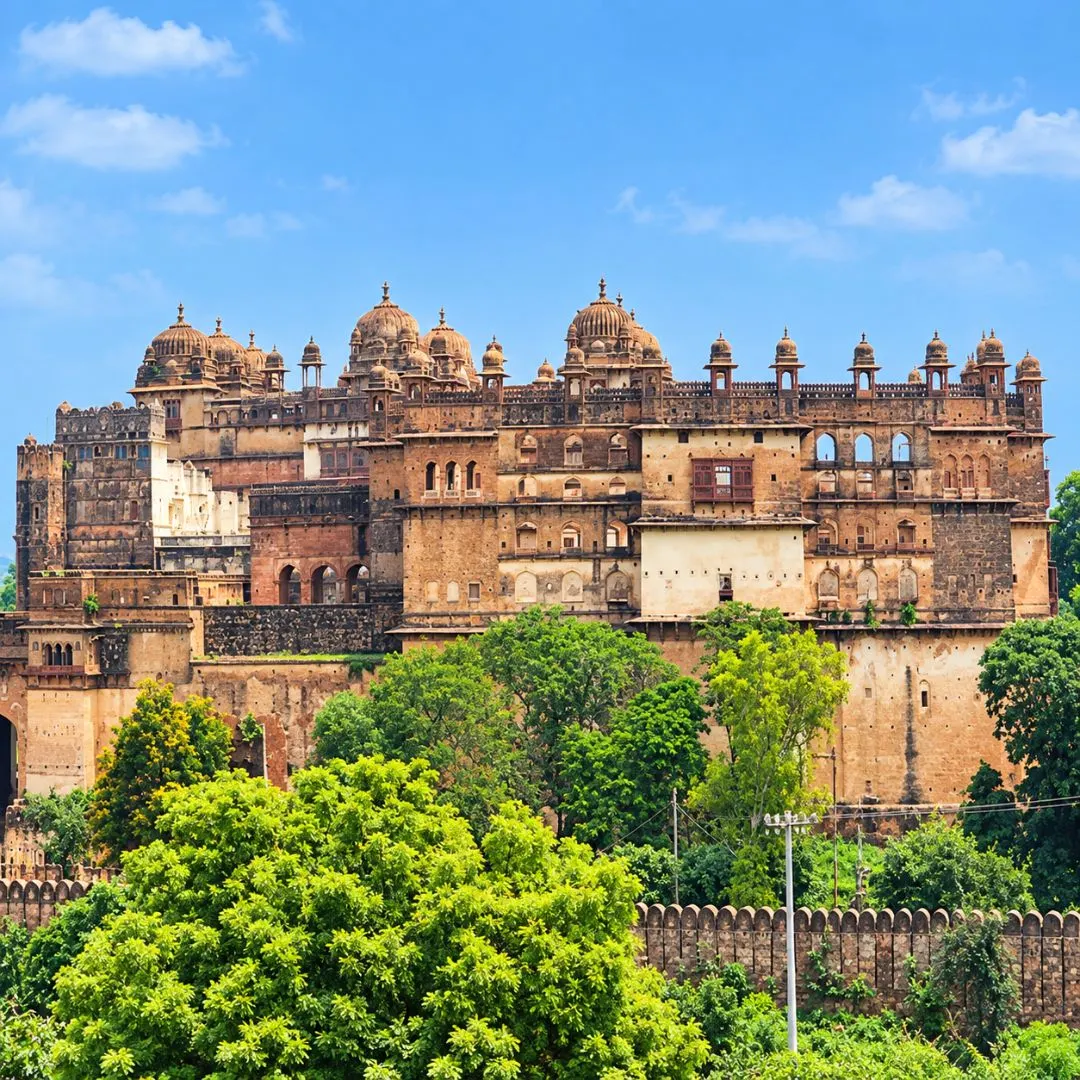
Built in 1501 AD by Rudra Pratap Singh and expanded over generations, the fort complex blends Rajput and Mughal architecture. Its most iconic structure, Jahangir Mahal, was constructed by Bir Singh Deo in the early 17th century to honour Mughal Emperor Jahangir's visit — its distinctive "pepper pot and dome" design later influenced Edwin Lutyens' architecture in New Delhi.
Location: On an island at the confluence of the Betwa and Jamni rivers, right at the entrance to Orchha town.
Distance: Central to Orchha; about 18 km from Jhansi and 155–170 km from Khajuraho.
Orchha fort is open daily from 8:00 AM to 6:00 PM. Early morning (soon after opening) or the last hour before closing are the best windows to visit, when the light is softer and the crowds thinner.
A single composite ticket covers Jahangir Mahal, Raja Mahal, the Royal Chhatris, and Chaturbhuj/Laxmi Narayan Temple, priced at around 10–25 for Indian nationals and 250 for foreign nationals, with an extra 25 for a camera and 200 for a video camera. It is valid only on the day of purchase.
3. Chaturbhuj Temple Orchha
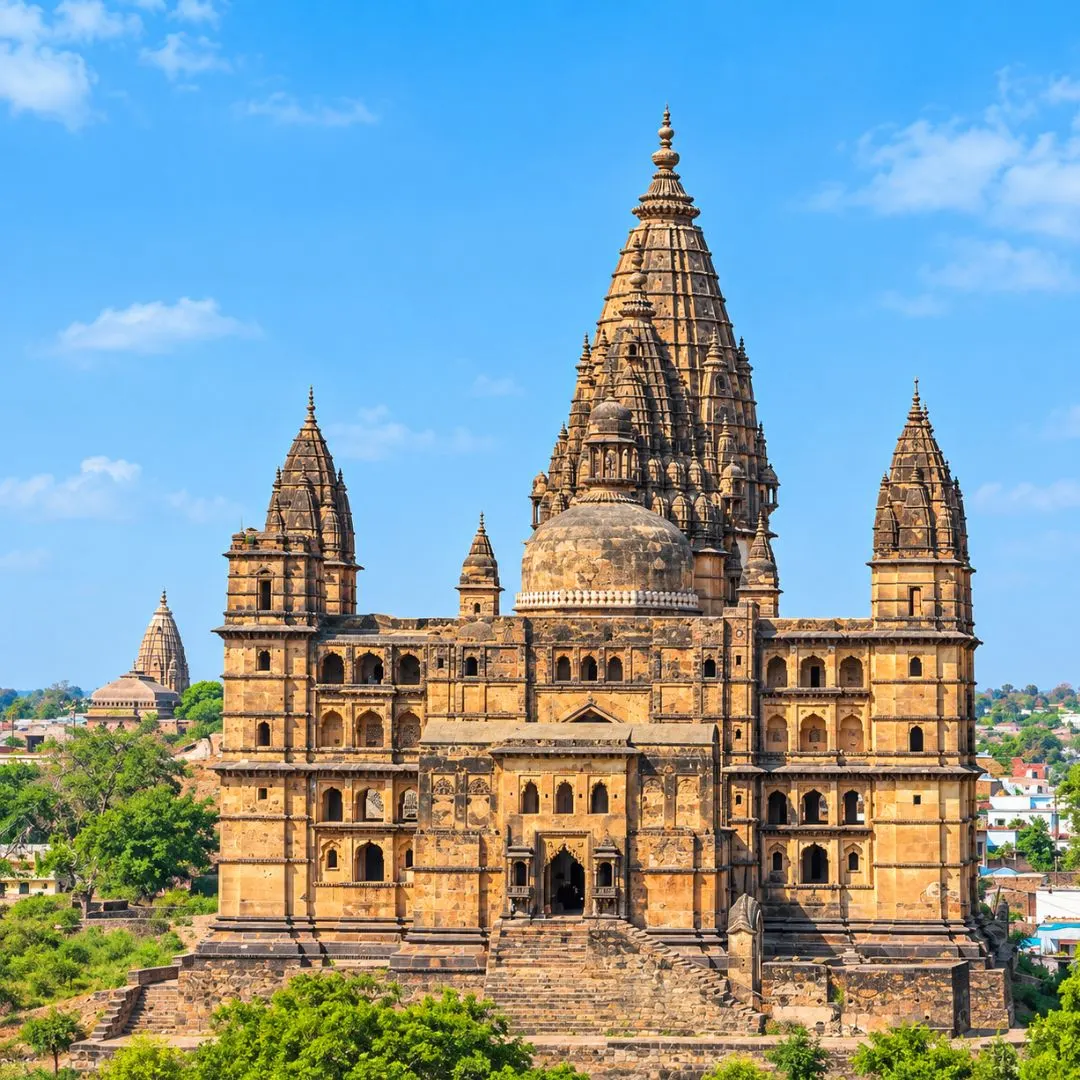
Construction began in 1558 under Madhukar Shah and was completed by his son Bir Singh Deo. It was built specifically to house the Rama idol Queen Ganesh Kunwari brought from Ayodhya — but since the idol refused to leave the palace (now Ram Raja Temple) once placed there, Chaturbhuj Temple's own sanctum was left empty and an image of Radha-Krishna was installed instead.
"Chaturbhuj" means "one with four arms," referring to Vishnu (of whom Rama is an avatar). Though built as Rama's true home, locals see the temple's empty destiny as
intertwined with Ram Raja Temple's story — together the two sites are viewed as one continuous act of divine will, and both are visited as a pair by most pilgrims.
Location: Directly opposite Raja Mahal, between Ram Raja Temple and the Orchha Fort Complex.
Distance: About 500 metres from Ram Raja Temple; 18 km from Jhansi.
With one of the tallest temple spires (vimana) in India at roughly 344 feet, Chaturbhuj Temple dominates Orchha's skyline. Its architecture is a rare hybrid of temple, fort, and palace design — thick walls, high arched doorways built for elephant processions, and a soaring central tower — making it a favourite for photographers and architecture enthusiasts.
4. The Royal Chhatris Orchha
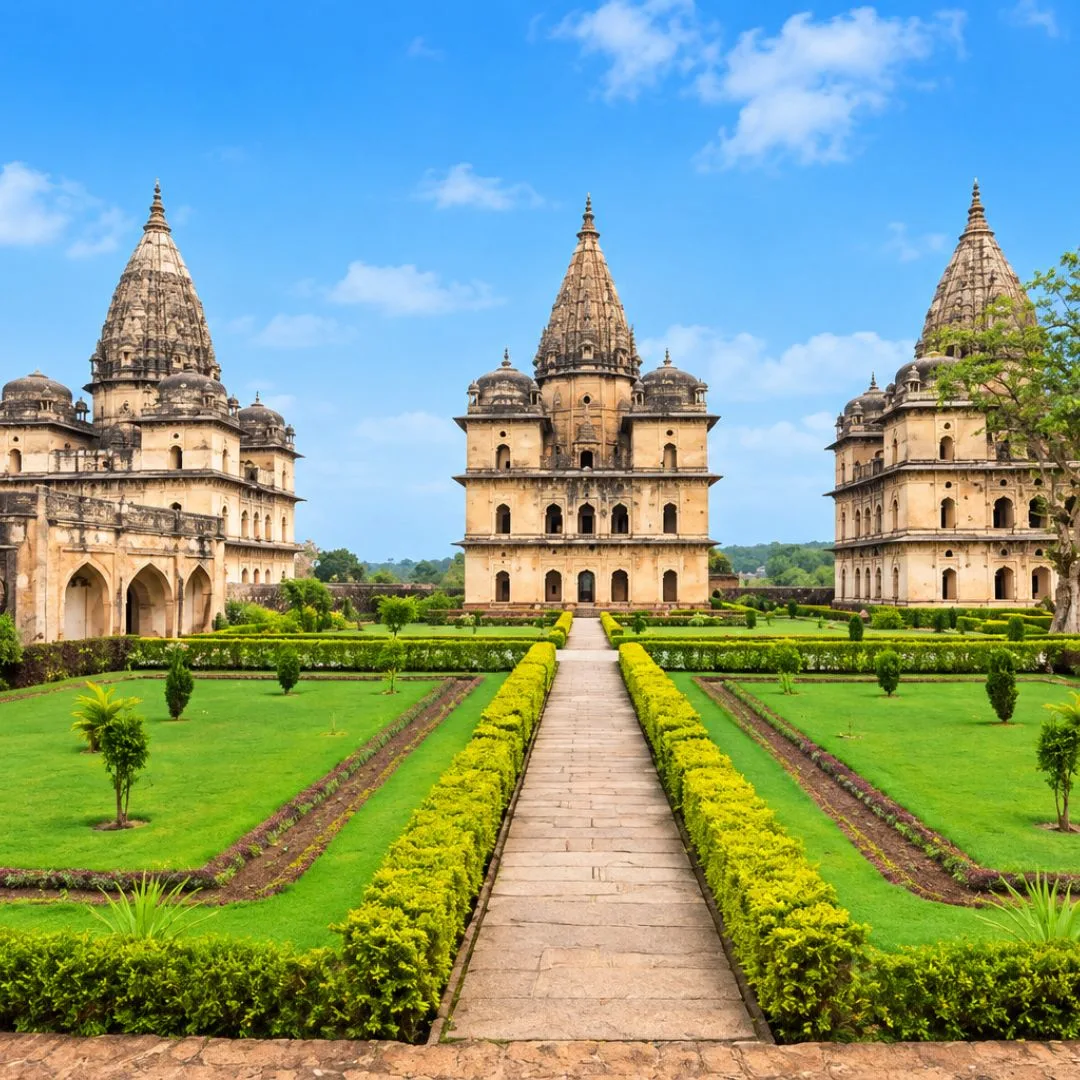
These are memorial cenotaphs of Orchha's Bundela rulers, built between the 16th and 18th centuries along the Betwa River at Kanchan Ghat, where royal cremations took place. There are roughly 14 chhatris in total, with each structure's size reflecting the length of that ruler's reign — the most elaborate belongs to Raja Bir Singh Deo, whose three-storeyed cenotaph uniquely opens straight onto the river, said to let the king bathe in the afterlife.
Location: On the banks of the Betwa River, a short walk from Orchha Fort.
Distance: About 1–1.5 km from the fort complex; 18–19 km from Jhansi.
Timings: 9:00 AM to 6:00 PM daily. Early morning and the hour before closing (sunset) are the best times to visit, when the light over the river is at its most
dramatic.
The Royal Chhatris are included in the composite Orchha Fort Complex ticket — around ₹10–25 for Indian nationals and ₹250 for foreign nationals — the same ticket that also covers Jahangir Mahal, Raja Mahal, and Chaturbhuj/Laxmi Narayan Temple. No separate ticket is needed if you already hold the fort combo pass.
The chhatris are best experienced at sunset, when their temple-style shikhara spires turn into dramatic silhouettes against an orange sky reflected in the river —
widely considered Orchha's most photogenic spot. You can also combine the visit with river rafting or boating on the Betwa, which starts nearby.
5. Laxmi Temple Orchha
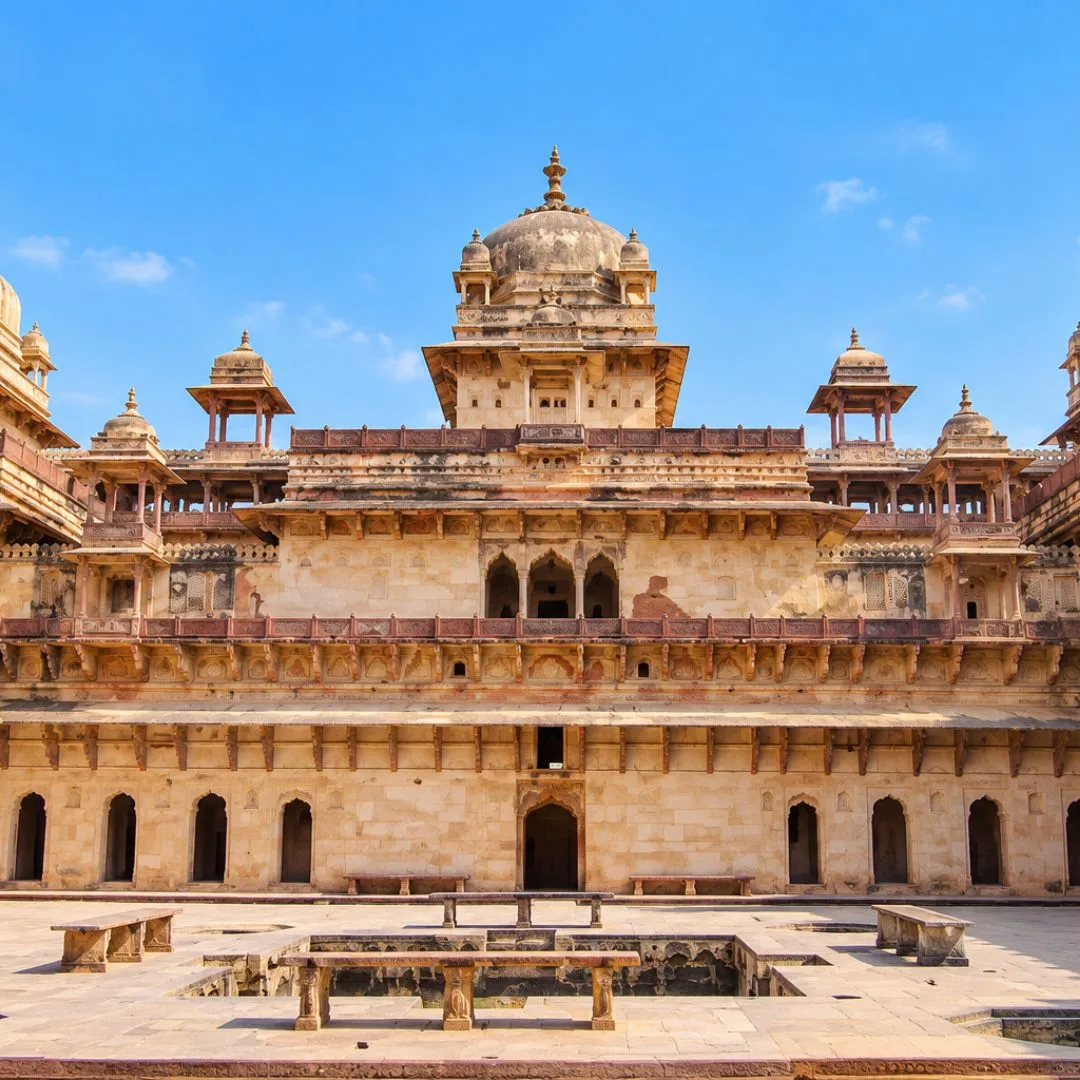
Built by Raja Bir Singh Deo in 1622, this temple is dedicated to Goddess Lakshmi, the Hindu goddess of wealth. Damaged by neglect over time, it was reconstructed by Prithvi Singh in 1793 and remains one of Orchha's three most significant temples.
Location: On a hillock at the western edge of Orchha town, offering panoramic views back over the fort and chhatris.
Distance: About 2 km from Orchha Fort Complex; 18 km from Jhansi.
Timings: 9:00 AM to 5:00 PM daily. Entry is covered under the composite Orchha Fort Complex ticket, so visitors already holding that pass don't need a separate one.
It is best paired with a Chhatris or Ram Raja Temple visit since all three sit within easy walking distance of each other.
The temple is architecturally unique — a rare fusion of temple and fort design, built with lime mortar and brick and fitted with cannon slots for defence, unlike any other shrine in the region. Its interior walls carry vivid frescoes and murals, some depicting 19th-century historical events, including scenes from 1857.
Devotees visit to seek Lakshmi's blessings for prosperity and wealth, and the temple is especially crowded during Diwali. Its elevated position is also considered
auspicious, symbolically placing the goddess "above" the town she watches over.